 KitDesk
Kit that leaves the building: what to agree first
Off-site loans are where kit stops being covered and starts being one person's word against another's. What the booking record holds, and what it doesn't.
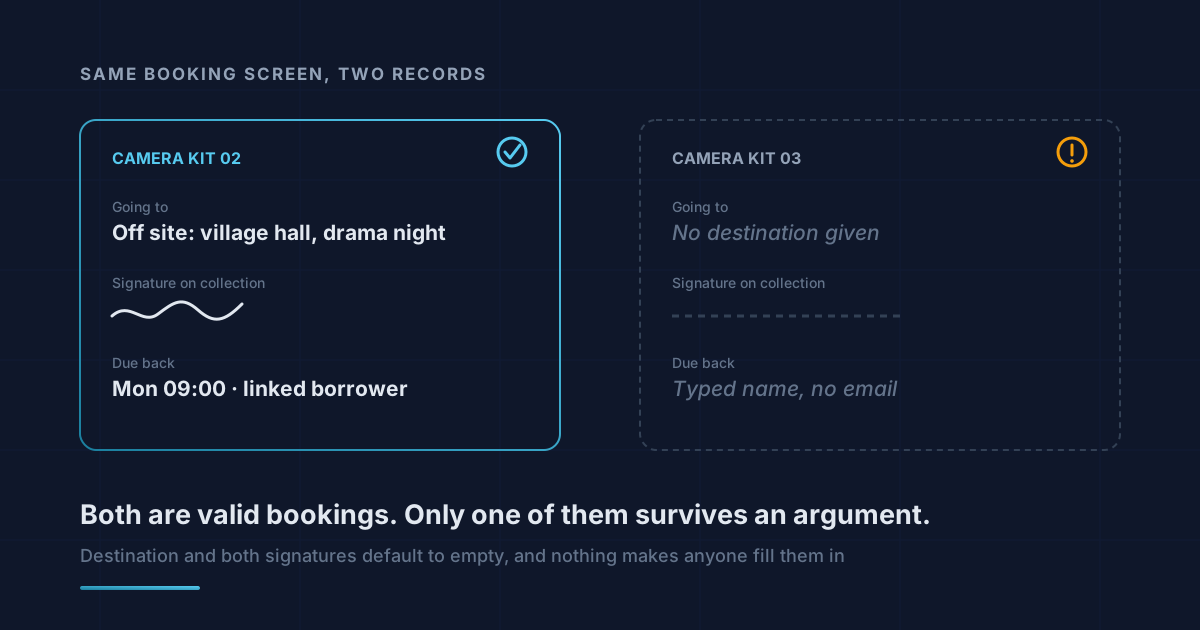
A projector going to the main hall and a projector going home in someone's boot are the same booking as far as most systems are concerned. They are not the same risk, and if something happens to the second one, the conversation afterwards is very different.
Off-site is usually a different question for your cover
Most state schools now sit under the DfE's Risk Protection Arrangement rather than a commercial policy. The RPA covers the risks a standard school policy would, to the scope and limits of your membership, and that last clause is the one that matters here. Whether a camera stolen from a car boot on a Saturday is covered is a membership-rules question, not a general one.
Hire firms and clubs have the same problem in a different wrapper. Commercial policies routinely separate contents at the premises from property away from the premises, and the second usually carries its own limit, sometimes a low one.
We can't tell you what your cover says. What we can tell you is that "is this covered off site, and up to what value?" is a question with a real answer that somebody in your organisation can go and look up in an afternoon, and that most people asking it for the first time are asking after the incident rather than before.
The destination box is free text, and empty by default
KitDesk has a destination field on every booking. The form suggests the shape of it, "e.g. Main hall, open evening", and whatever you type shows on the booking list, on the item's card, and in the confirmation email as a "Going to" line.
It is also, in the data model, a plain string that defaults to empty. Nothing requires it. Nobody is stopped from booking a laptop for a fortnight with the destination blank, and the list will happily show "No destination given" next to it forever.
That's a design decision rather than an oversight, because plenty of bookings genuinely are just "the room next door". But it means the difference between your on-site and off-site loans lives entirely in whether people type in a box. If off-site cover matters to you, the enforcement is a habit and a house rule, not a validation error.
The practical version: agree one convention and use it. "Off site" as the first two words of the destination for anything leaving the building makes the whole thing greppable later, which is worth more than a beautifully worded sentence nobody can search.
Who can actually send kit out
Approvals in KitDesk are narrower than people assume. A booking goes to "requested" instead of straight to "reserved" only when two things are true at once: the approvals feature is switched on for your organisation, and the person booking has the staff role. Admins and owners never trip the gate. Their bookings are reserved the moment they're made.
So if the person most likely to take a £2,000 camera to a weekend event is an admin, no approval step exists for that booking, and nothing in the system will tell you it happened until you look.
When the gate does apply it works properly. Every active admin and owner with notifications on gets an email, the approver can decline with a note, and an unapproved booking can't be checked out at all: the API returns a flat "Not approved yet" and refuses. There's more on that flow in booking approvals.
The question worth asking is not whether approvals are on. It's whether the people who take the most valuable kit off site are the same people who can approve their own bookings.
Signatures, and what they're worth
The check-out screen offers a signature on collection, and the return screen offers one on the way back. Both are stored on the booking as signatureOut and signatureIn.
Both default to empty. Neither is required to complete the action. A member of staff can check a booking out, and back in, without anyone signing anything, and the booking will look complete afterwards apart from two blank fields nobody looks at.
That said, when they are used they're doing the useful half of the job. A signature on collection makes "I never took it" a much harder position, and a signature on return does the same for "I definitely brought it back". If your off-site loans go to people outside your organisation, parents, contractors, hall hirers, those two fields are the closest thing you have to a receipt.
What the record won't tell you afterwards
Three gaps worth knowing before you rely on this in an argument.
There's no separate off-site flag. Reporting on what left the premises means reading destination text, which is why the convention above matters.
There's no value on the booking. The item has a name and a reference, and the booking has a charge field for hire, but nothing tots up what walked out of the door on any given day. If you want a "what's off site right now, and roughly what's it worth" number, that's an inventory export and a spreadsheet.
And condition on the way out isn't recorded as a condition. Condition is captured on return, as good, fair or damaged, with damaged being the only one that pulls the item off the shelf. There is no matching "it left in good nick" tick at check-out, so a dispute about pre-existing damage comes down to the collection signature and whatever anyone remembers. If that risk is real for your kit, a photo attached to the booking before it goes is worth more than any field we could add. See what happens when someone marks kit damaged for how the return side behaves.
Before it leaves
Five things, none of which need software:
Ask your insurer or read your RPA membership rules for the off-site position, and write the answer somewhere staff can find it. Decide who is allowed to authorise kit leaving the building, and check whether the system's approval gate actually catches those people. Agree a destination convention and use it every time. Take the signature on collection, especially for anyone outside your organisation. And make sure the person taking it knows the return date, which means the booking needs a linked borrower with an email rather than a typed name, or the overdue chase goes nowhere at all, as covered in borrower records.
The kit that goes missing is rarely stolen. It's usually in the boot of a car belonging to someone who fully intends to bring it back, and who nobody can email.
Tracking equipment the hard way?
KitDesk does the boring part: labels, bookings, reminders and a list of what never came back.
Try the demo